
Tag: Blog

  • The Necessity of Policies in Effective Leadership

    The Necessity of Policies in Effective Leadership

    This article discusses why good leadership is not enough, but excellent policies keep healthy leadership on track. 4-Minute read.

    Cynicism is the only form in which base souls approach honesty. – Nietzsche 

    My spouse and I recently had a conversation trying to identify when we “became cynical”. We remembered our twenties, when we had endless energy and truly believed we could make lasting changes. In hindsight, we weren’t always right—but sometimes we were. Back then, we were willing to try, protest, scheme, and jump into things that today we might hesitate to begin. (History shows this is universal: young people’s energy and belief, even when overwhelming, is what pushes the rest of us forward.)

    In a recent training I was asked to think of the best leaders or mentors I’ve worked with. I realized I could recall many poor leaders and a few others with admirable qualities—but even the best had clear shortcomings. In a rather generous moment, I told my spouse that I am sure that others feel the same way about my leadership—he, less generously, had a good laugh. Presumably, he agrees.

    In the Room Where it Happens – Hamilton (Lin-Manuel Miranda)

    Growing up, I was a theater kid (*jazz-hands*). Anyone who’s been backstage knows how wildly different it is from what the audience sees. Up close, the makeup is harsh, and tights, wigs, costumes, flowers, and hairspray pile up everywhere. Sets are often held together with duct tape, zip ties and sparkle glue. But if the audience never sees the chaos, the show goes on and everyone claps.

    There comes a point in your life and career when you finally “see behind the curtain.” You’re no longer just an observer—you become part of the production, seeing how things really work. You quickly realize that the solutions you once imagined won’t magically fix everything. The real‑time complexity and mess are often held together with little more than sparkle glue and zip ties.

    So, is that it? Do we have a few years of hopeful enthusiasm until we realize that people are emotional and fallible even when they’re in charge?  

    Policy sits above conscience. – William Shakespeare

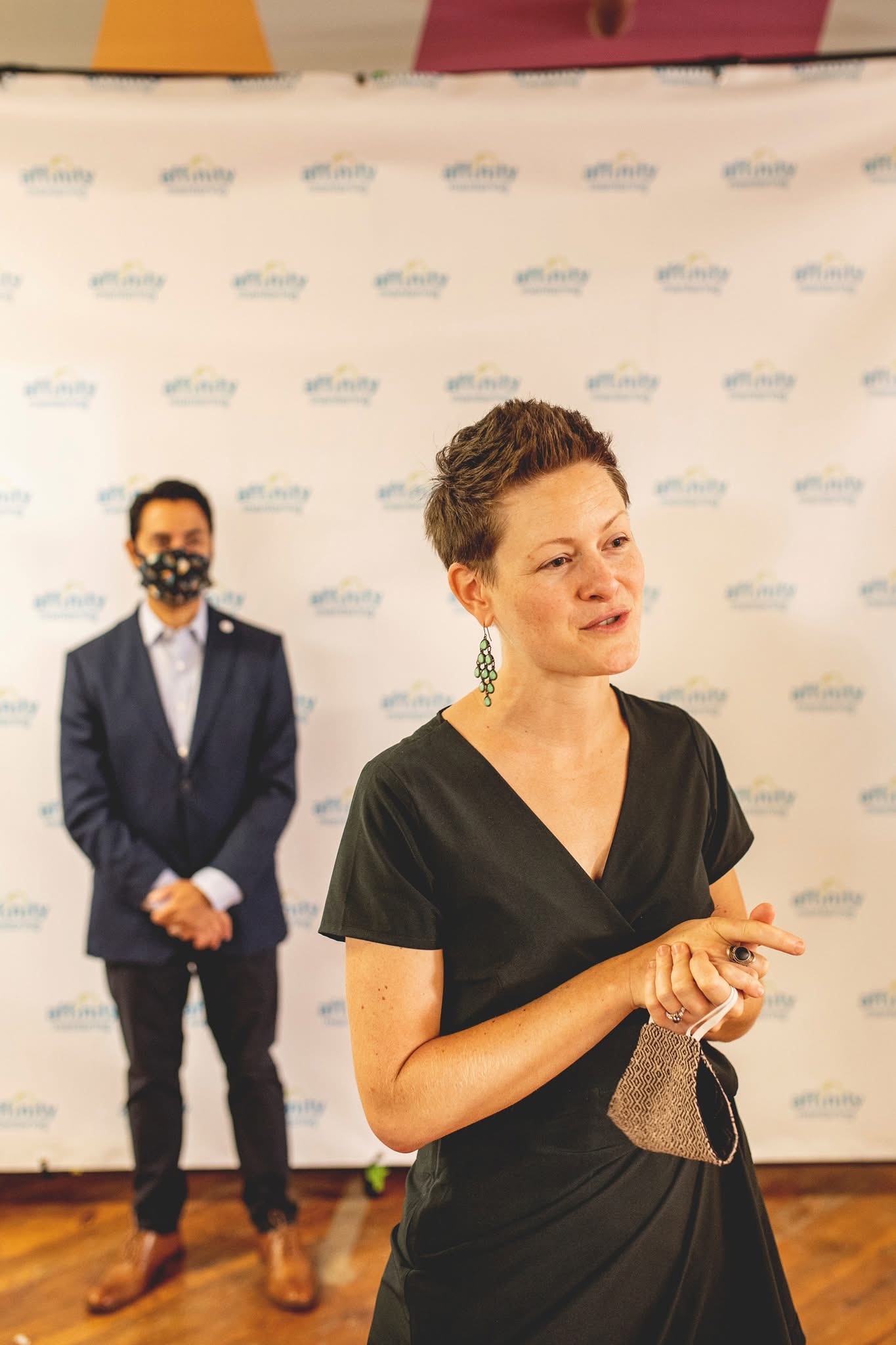
    I became the Executive Director of a school-based non-profit in May of 2020. (Learn more about my experience at Affinity Mentoring through this Case Study.) I can truly say that it was my first and most abundant opportunity to lead at scale, and I did it with enthusiasm and passion. Despite significant challenges, we increased revenue, improved salaries, expanded our staff and board, strengthened partnerships, improved outcomes, and advanced equity. When I left two years later, I was deeply proud of what we accomplished together and of how much I had grown as a leader.

    And yet. I had bad days. I worked better with some staff than others. I made mistakes. Some ideas flopped. I made reactive choices when I should have paused. I was far from perfect. Therefore, in anticipation of my own failures, I was diligent about creating policies and practices that could uphold my best values when I failed. I was consistent in writing them down and making them financially and legally enforceable, ensuring others could call upon them and keep me in check when needed.

    A group of Affinity Mentoring staff smiling and making silly faces at an event.

    The best way to predict your future is to create it. – Peter Drucker

    Leaders: keep learning, seek feedback, take criticism with perspective, and invest in your own growth. Leaders: anticipate your humanity—you will fail, so plan for it. Set clear goals to realign with when you drift. Create written, well‑funded policies that protect staff wellbeing when you have competing priorities. Document your practices so new people understand them. And as your reach expands, set regular check‑ins to ensure you are growing sustainability.

    Simon Sinek famously said, “culture eats strategy for breakfast”. Guess what, Simon. I want both! Our tagline at Consulting for Resilience is “Change is inevitable. Resilience is intentional.” Things that will change include: the economy, funding, public opinion, politics, generational trends, AI, your health, your relationships, your energy levels, how much sleep you get every night, what medications you take, your family’s health, and everything else in between. Change is inevitable, in your environment, and in yourself. Resilience requires intentionality, for both your strategy and your culture.

    Being in the room where it happens—or seeing behind the curtain—is a real privilege. Don’t take it for granted by assuming you’ll hit every cue or never miss a line. Instead, plan ahead. Build tools and policies that guide you and everyone else when change inevitably comes.

    Email cassandra@consultingforresilience.com to learn more; let’s plan resiliently together.

    – Cassandra Kiger, CEO of Consulting for Resilience
  • Introducing Consulting for Resilience

    Introducing Consulting for Resilience

    Learn more about CEO Cassandra Kiger’s entrepreneurial journey and how the launch of CFR is a call to accept the changes around us and build resiliently. A 5-minute read.

    Welcome to the launch of Consulting for Resilience! I am so grateful that you are here, whether as an interested party or a casual passerby. I’m hopeful that in some way we can support each others’ work and find ways to build a more resilient future together. 

    This launch is with the support, knowledge, and expertise of dozens of amazing people who have helped steer a concept into a reality. Just to name a few: Paul Kiger, Rae Humphreys and Mas Marketing, Tivi Jones, Kristine Sloan, Erica Madden, Jessica Davis, Shaleiah Fox, Pat Sosa Verduin, and John Regan.

    A Life-Long Entrepreneur

    I was born and bred an entrepreneur in an entrepreneurial household. My dad’s first LLC is named after my older brother’s initials, placing just two of his biggest creations in an even smaller Venn diagram some 40+ years ago. As for myself, my first business transactions took place when I was in charge of the farm’s chicken coop and began selling free-range eggs for 50 cents a dozen (inflation, am I right?!). I was a hustler from the start. When my grandmother very kindly asked if she might get a discount on her dozen eggs, I drove her a hard bargain at 50% off, but only if she paid up front in cash. I was four years old.

    By the time I turned eleven I had a semi-official loan taken out through my dad’s bank account (banks, very reasonably, won’t loan to 11-year-olds) and bought two vending machines that I set up in the warehouse of his business. I would spend the next five years begging rides and checkbook signatures off of my parents so that I could go to Sam’s Club and use every ounce of my body weight to haul around dollies with cases of pop and snacks towering taller than I was. I would spend weekends packing and fixing machines and counting quarters like a tiny gangster. This business was my first opportunity to play with growth and expansion, and I spent summer days walking around to the 100+ employees and getting their survey feedback on what items they would like to see in the machines and how I could improve services. I partnered with the HR team when they had company-wide weight loss and steps challenges to give healthier food options, and I began cleaning the microwave and kitchen areas so that my microwaveable soups sold better in the winter months when the warehouse was cold. One of my biggest growth investments early on was the acquisition of an automatic change counter that counted and rolled my hard-earned quarters, dimes, and nickels into little rolls that I could deposit into my account and pay off my loan with. When I was nearly 16 I sold the business for a profit to another employee at the warehouse and put the money towards my car fund.

    Graphic featuring the text 'Build Systems that Rise Stronger.' with a subtitle 'Change is inevitable. Resilience is intentional.' against a blue scalloped background and an illustrated logo.

    Building Resilience

    Throughout my entire career I have nailed the “diversified income” checkbox, having as many side-hustles as I could fit into the week to make the budget work. It has allowed me to invest in myself professionally, and ensured that when one option ended, I had others to fall back on. Until this past year, that is.

    The year 2025 was not the first time I’ve lost a job to political and congressional funding changes, by any means, but it was the first time that I looked at the budget, realized what new political changes would mean for my role, and I didn’t have a back up plan. I have three college degrees and an enormous range of experience, and I had no idea how I was going to use any of that to pay the bills and contribute to my community when it needs it the most. I was caught on my heels and realized I needed to make a change.

    I have spent well over a decade professionally working to build people, programs, systems, and organizations that are resilient. I have worked in refugee resettlement, foster care, child abuse prevention and healing, mentoring, workforce development, local government, and every field I have ever worked in has started from the basis of saying, “this person or community or group has taken an awful hit; now what do we do”? How do we take something awful and build resiliently from the ashes? How do we reteach our brains, our bodies, our organizations, and our communities that something ending or changing, even tragically, does not mean it is the end?

    I spent a career working with this consistent goal in mind, and yet I was not prepared to respond resiliently myself. Therefore, to those of you wondering why I am launching Consulting for Resilience now? Why I am launching it when I am not ending my current employment? Because it is time that I take my own good advice and remember to build resiliently. 

    Resilience grows a lot like a meditation practice. (Meditation is actually a key way to grow neurological resilience.) “Doing meditation correctly” is just taking a lot of tiny steps to plan to meditate regularly, and then spending time observing, (the body, the brain, the environment), without immediately trying to change anything. 

    You spend this time simply listening, reflecting, allowing observations to come and go, and often you find key moments of growth and alignment that bring you closer towards your goals without having had any large “outputs”. You grow more mentally flexible, you increase your mental and emotional capacity, and the next time life throws something hard at you, you can pivot easier and with less distress. 

    Build With Us

    Consulting for Resilience is my professional “meditation”. I am doing what I do best and growing my own personal and professional resilience in this moment, without undue anxiety or judgement. In the coming weeks and months, I will share more about what resiliency-building looks like, and why it should be a priority in our work at this exact moment. In the meantime, I encourage you to visit consultingforresilience.com and learn the basics of the business. I would love to hear from you in the comments or via email (cassandra@consultingforresilience.com) about how you are building resiliently even in 2026, or areas where you see the need for it. If I can, I would love to support you in building resiliently. Mostly, I want us to keep waking up each day with a little bit of tenacity and grit, with a lot of kindness for ourselves and others, and with our minds equally balanced to solve the immediate needs before us, while also being prepared to pivot the moment when things change and are born anew.

    How will you grow resiliently? Change is inevitable. Resilience is intentional.

    – Cassandra Kiger, CEO of Consulting for Resilience